All Categories
Featured
Table of Contents
Strong compliance practices likewise decrease legal risks and protect delicate HR data. Key concerns include: Protecting employee dataMeeting personal privacy regulationsPreventing security breachesMaintaining staff member trustReducing legal and financial threats helps HR groups automate recurring tasks, improve working with choices, individualize learning, and forecast labor force patterns. It enables HR experts to spend more time on tactical efforts while improving the worker experience.

It improves flexibility, supports profession growth, and helps organizations remain competitive in a rapidly altering business environment. Organizations assistance continuous learning through: Upskilling and reskilling programsLearning management systems (LMS)MicrolearningLeadership developmentPersonalized learning courses Author Srikant Chellappa CEO & Co-Founder of Engagedly Srikant Chellappa is the Co-Founder and CEO at Engagedly and is an enthusiastic business owner and people leader.
What's the greatest skill challenge you're taking on in 2025? This year, skill management isn't just a functionit's an organization driver, straight affecting development and innovation. From reassessing hybrid work models to focusing on for skill management and hiring, 2025 needs vibrant, transformative techniques for success.
Enterprise Process Refinement in the 2026 EraThe past year "has actually been rough" in recruiting, both the market and the occupation, Kevin Grossman, president of the Skill Board, informs HRE. Doing recruiting work was hard as the labor market tightened up, and lots of talent acquisition specialists, especially in innovation, lost their tasks in 2023, he states. Kevin Grossman, Talent Board TA roles in health care, hospitality, retail and some other markets were more resilient in 2015.
How Labor Market Dynamics Impact GCC Strategy in 2026
The Skill Board asks employers every month whether they are working with and whether they are increasing the size of their recruiting groups. "There's been an uptick in the 'increase' answers and reactions," Grossman says.
Numerous companies are going back to the pre-pandemic practice of preferring to work with in your area instead of thinking about the international skill pool, says Robert Kelley, professor of management at Carnegie Mellon University's Tepper School of Company. Robert Kelley, Carnegie Mellon University In his conversations with companies, "A great deal of C-suite executives are saying if workers won't come back to the office, we'll just work with somebody else [in your area]," he states.
An international technique also can lower employer expenses.
Next year, as the presidential election season warms up with primaries, celebration conventions and ultimately, the Nov. 5 election, professionals anticipate that workers will continue to speak up about political and social causes. employers that previously took neutral stands on workplace discussions of politics, sex and religion require to be prepared, Kelley advises.
"And if they do not, there's [singing] backlash." The U.S. economy and labor force are still adapting to the aftermath of the COVID-19 pandemic, Kelley states. Most just recently, that centered around returning to offices: C-suite executives want it, and workers do not. "It's set up an unhealthy dynamic," he states. "I do not think that's been settled yet, and I think it will continue into 2024." In May, for example, Amazon workers went out in protest of the retail giant's three-day-a-week obligatory return-to-office policy, calling for a versatile workplace policy.
Evolution of Global Capability Centers in 2026
The e-commerce leviathan is not alone. Other business are likewise setting up RTO enforcement policies that can cause termination. Several unions, consisting of the prominent United Auto Employees, Writers Guild of America and SAG/AFTRA, scored major victories this year after prolonged strikes. Scott Cawood, WorldatWork Seeing that, "one might expect organized labor interests to keep their foot on the gas pedal and push for more gains," forecasts Scott Cawood, CEO of WorldatWork, a non-profit organization for overall rewards specialists.
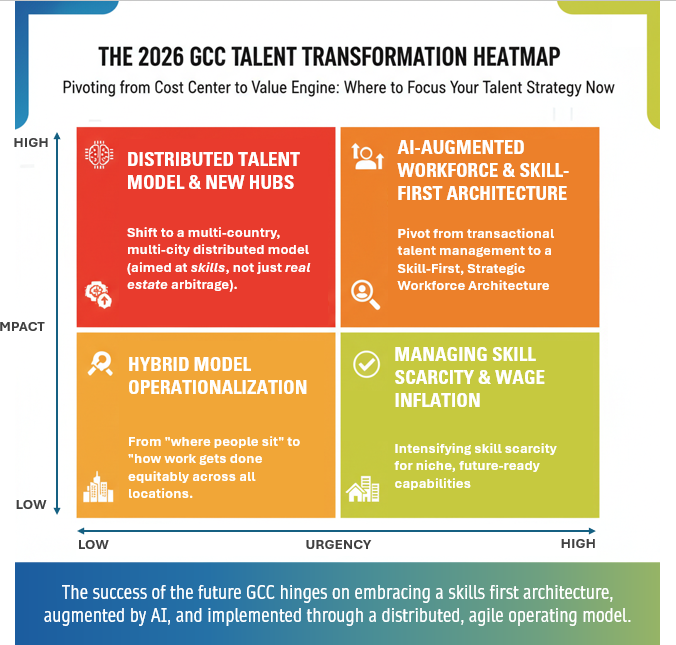
The advancement of skills architectures will increase next year, Katy George, primary people officer with McKinsey & Company, tells HRE, due to the fact that of their guarantee to assist employers both hire external candidates and promote internal prospects based on their skills. "The majority of organizations are moving toward some type of skills architecture," she states.
And by 2025, Gen Z is expected to account for more than a quarter of the labor force, says Blair Ciesil, senior partner with McKinsey & Company.
"These [concepts] are all going to be something huge to think about when we consider the messages to assist distinguish profession opportunities for Gen Z and also how we establish that talent," Ciesil states.
A new research study by Right Management has actually offered a global summary of skill management patterns. The survey had 2,200 participants from 13 countries and 24 markets, all of whom were magnate of HR experts. When asked to identify the single most important skill management obstacle facing their organisation, the bulk of individuals cited an absence of competent skill for key positions; 28% of worldwide respondents called this concern.
Why Labor Market Dynamics Impact GCC Strategy in 2026
Other aspects which were named as issue causers were less than optimal employee engagement, too few high-potential leaders in the organisation, a loss of leading skill to other organisations and lagging productivity. Scientists also asked the study's individuals how their organisation was buying and establishing talent. Looking for to develop the abilities of every worker was a popular method, along with seeking to provide development chances to all workers over a 3rd of the participants stated that their organisation took these techniques to talent advancement.
Professional Analysis of GCC Dynamics in 2026Identifying key factors and targeting them for advancement efforts was another popular technique for purchasing skill development, with a quarter of international respondents naming this as the favored approach in their organisation. Virtually none of the participants said that investment in talent was restricted or non-existent; worldwide, just 1% of individuals offered this reaction.
Twenty-five years because the term "War for Skill" was very first coined by Steven Hankin at McKinsey & Co., intense competitors for abilities and experience still becomes an important concern among organisations, above all other skill obstacles. Skill tourist attraction is not just a short-term priorityit's a long-lasting competitive benefit. We need to rethink how we position our organisations as companies of option.
Navigating International Labor Laws for Global Teams
For little to mid-sized organisations, the ability to draw in specific niche skillsets is specifically challenging. of HR leaders mention Skill Tourist attraction as either: External factors such as (61%) and (50%) remain key obstacles in efforts to draw in and keep talent. Based upon our study, small organisations (500999 staff members) will greatly depend upon AI-driven recruitment tools to scale effectively.

Latest Posts
Optimizing Business Process Performance GCC Scaling
Navigating Global Workforce Law Changes in Future
Leveraging GCC Frameworks for Strategic Cost Reduction